
Santa Clarita Sewer Repair: Project example: a 110-foot sewer lateral on a Sand Canyon property, lined from the inside to avoid trenching through oak root zones — what it involves and what it costs
Santa Clarita Sewer Repair walks through a typical long-run project for a custom home on acreage in Sand Canyon: a 110-foot clay sewer lateral that passes near mature oak trees on its way to the street, with roots and cracks along the run, cleaned and lined with cured-in-place pipe so no trench has to cross the oaks' root zones.
Bookings aren't open yet. Leave your name and number; your message is recorded, and you'll get one message when a local installer is available.
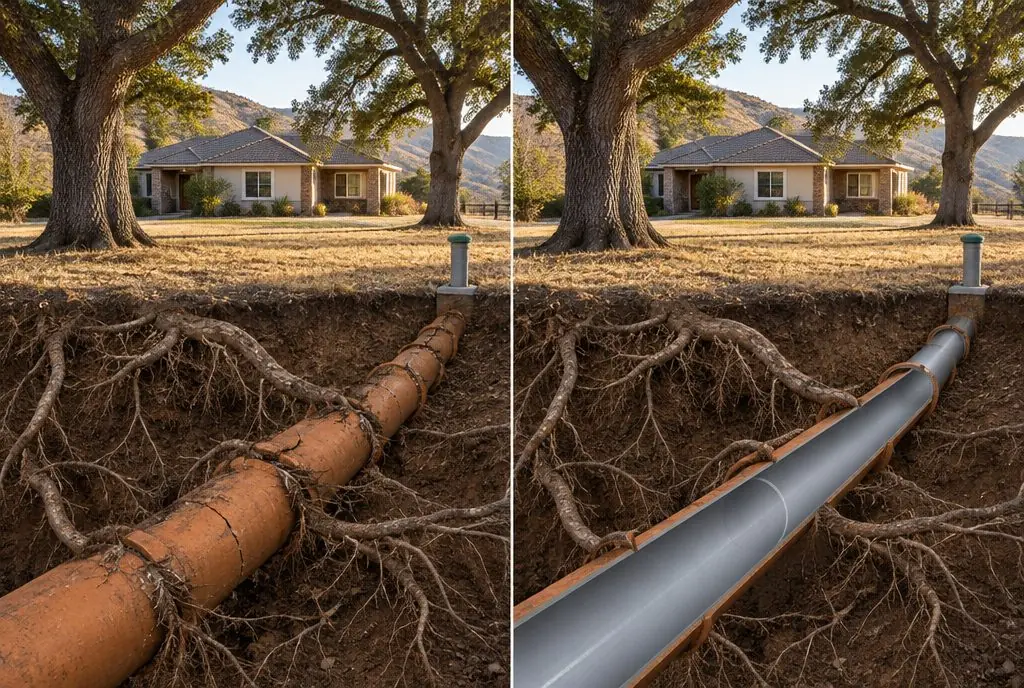
Worked example. The pictures are AI concept illustrations, not photographs; no installation was performed or arranged through this site; prices are typical Santa Clarita Valley market ranges, not quotes.
 Illustration
Starting pointFinished layout (concept)
Illustration
Starting pointFinished layout (concept)
Project Examples & Typical Prices
The scenario
The property is a custom home on acreage in Sand Canyon, set back from the road with a long driveway and two large oak trees in the front yard. The sewer lateral runs about 110 feet from the house to the street, and its path passes within the root zones of both oaks. It is clay pipe, laid in sections, and the camera shows what clay near large trees usually shows: roots at many joints and a few longitudinal cracks, with the pipe still round and on a steady slope.
Trenching along this route would cut through the oaks' root zones. In Santa Clarita, oak trees are protected, and work inside an oak's protected zone generally needs a city permit and care that limits what can be done; the city's oak tree rules confirm what applies to a specific tree. Avoiding a trench near the oaks is therefore not just a preference but the practical way to keep the project simple.
The property at a glance:
- Run: about 110 feet from the house to the street
- Pipe: clay, round and on grade, roots at many joints, some cracks
- Trees: two mature oaks with root zones over the pipe route
- Access: a cleanout near the house; a long front yard of dry grass
- Surface: no hardscape over the route except the driveway apron at the street
What the job involves
- The lateral is scoped from the cleanout to the street, the route is traced with a sonde and a locator and marked relative to the oaks, and the video is reviewed to confirm the pipe is round and passable along the whole run.
- The line is cleaned with a hydro jetter and a root-cutting head, removing the roots at every joint, and scoped again so the liner is installed into clean pipe.
- Because the run is long, the liner is planned in one continuous shot from the cleanout if the system allows that length, or in two shots from a small access pit placed well outside the oak root zones.
- A felt liner tube is cut to the measured length and saturated with resin, then inverted into the pipe with air or water pressure so it presses against the old wall along the whole run.
- The resin is cured as the liner system specifies, the ends are trimmed and sealed, and the transition at the street end is checked.
- The finished line is scoped end to end, and the video showing the continuous liner past both oaks is left with the household.
Hardware and materials
- Cured-in-place liner sized to the pipe diameter and cut to the run length, with resin
- Inversion equipment using air or water pressure; curing equipment
- Hydro jetter with a root-cutting head
- Push camera with a sonde and a surface locator
- End seals and trimming tools
- Small excavation tools for an access pit, if the run is lined in two shots
What it typically costs in the Santa Clarita Valley
| Trenchless lining (cured-in-place pipe), 110 feet of sewer lateral installed ($80–$180 per foot) | $8,800–$19,800 |
| Camera inspection with video | +$150–$400 |
| Hydro jetting and root cutting | +$400–$800 |
| Typical total | $9,350–$21,000 (market range, not a quote) |
These are typical local ranges, not a quote or an offer; an installer prices the actual job after seeing the wall.
Add-ons often paired with this job
- New two-way cleanout — +$800–$2,000. A second cleanout part way along a long run makes future inspection and cleaning easier.
- Section under the street (public right of way) — +$3,000–$9,000. If the section under the street needs work, it is a separate right-of-way item with its own permit.
- Spot repair of one section — +$1,500–$4,000. A section that the liner cannot bridge, such as a sag, is repaired first, outside the oak root zones where possible.
Why it is done this way
Lining is the method that keeps excavation away from the oaks. The pipe is still round and on grade, so a liner can turn the clay run into a continuous pipe with no joints, sealing out the roots that have been getting in for years. Pipe bursting was the other trenchless option, but bursting fractures the old pipe outward into the soil, which is less attractive right under oak roots than a liner that stays inside the existing pipe.
A long run is the main technical challenge. Liner systems have practical length limits for a single shot, so the run is either lined in one continuous shot or split at an access pit placed deliberately outside the root zones.
What would change the price
- The run is too long for one liner shot — an access pit and a second shot add time and material.
- A section has a sag or collapse — a spot repair is needed before lining, which may involve the oak permit question.
- Heavy roots take longer to clear — extended jetting adds time.
- The section under the street needs work — separate permit and price range.
- A city oak tree permit is needed for any digging near the trees — fees, where they apply, are outside the estimator.
Where this leads
- Service page: Trenchless Sewer Lining (CIPP) — A resin liner cured inside the old pipe: a new jointless pipe without digging, for laterals that still hold their shape.
- Local page: Sewer line repair in Sand Canyon
- All services and typical prices: sewer line repair in Santa Clarita
- More worked examples: Project Examples & Typical Prices
Check availability and the price range for this setup
Bookings aren't open yet — describe the sewer line and you get a Santa Clarita price range right here. Typical Santa Clarita Valley installed prices for residential sewer lateral work, labor and materials. This is a market estimate, not a quote. Permit fees, inspection fees and street restoration charges, where they apply, are not included.