
Santa Clarita Sewer Repair: Project example: a 70-foot sewer lateral more than 6 feet deep, replaced by pipe bursting on a sloping Canyon Country lot — what it involves and what it costs
Santa Clarita Sewer Repair takes a typical deep-lateral job for a hillside tract home in Canyon Country: a 70-foot sewer lateral, cast iron where it leaves the house and clay through the yard, that runs more than 6 feet deep near the street because the lot sits below the road, replaced by pipe bursting so the deepest stretch never has to be trenched.
Bookings aren't open yet. Leave your name and number; your message is recorded, and you'll get one message when a local installer is available.
Worked example. The pictures are AI concept illustrations, not photographs; no installation was performed or arranged through this site; prices are typical Santa Clarita Valley market ranges, not quotes.
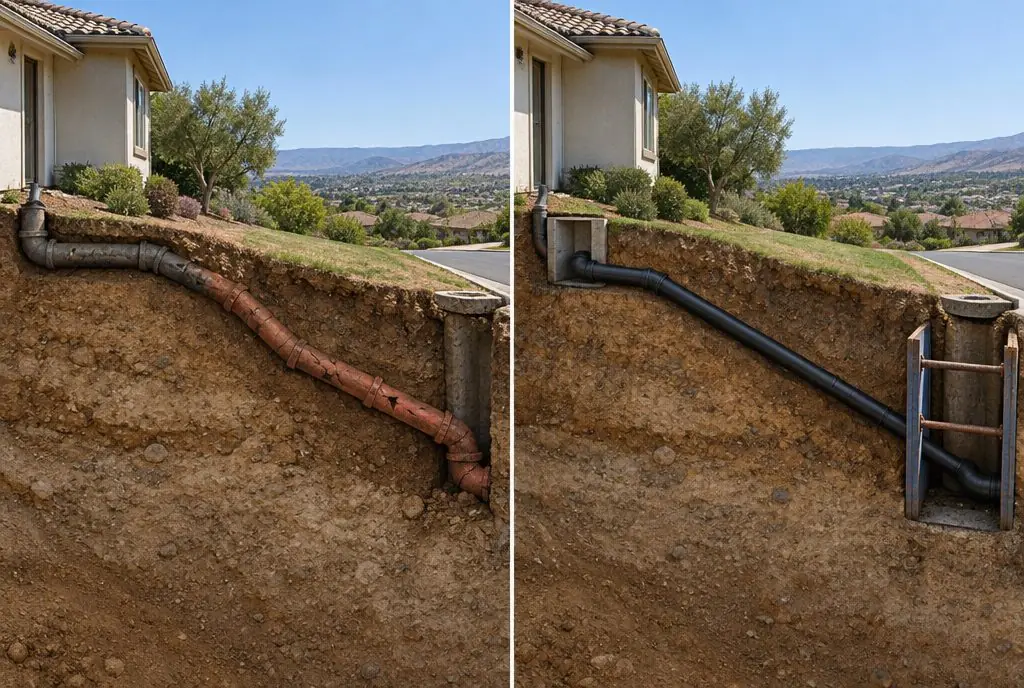 Illustration
Starting pointFinished layout (concept)
Illustration
Starting pointFinished layout (concept)
Project Examples & Typical Prices
The scenario
The house sits on one of the sloping lots in the canyons of Canyon Country, below the level of the street. Because sewage flows downhill to the public main, the lateral has to leave the house low and stay deep enough to reach the main at the right elevation, which means it runs more than 6 feet down near the street. The first few feet under the house are cast iron; the rest, about 60 feet through the yard, is clay.
A camera inspection after repeated slow drains shows cracked clay sections, roots at several joints and a cast iron section near the house with heavy scale but no holes. The run is continuous and passable. A trench more than 6 feet deep would need shoring along its whole length and would cut through the front landscaping and a concrete walkway, which is the main reason a trenchless method is considered first.
The site in short:
- Lot: below street level, steady fall from the street toward the house
- Depth: more than 6 feet near the street, shallower near the house
- Pipe: cast iron near the house, clay through the yard
- Defects: cracked clay, roots at joints, heavy scale in the cast iron
- Surface: front landscaping and a concrete walkway along the route
What the job involves
- The lateral is scoped end to end, the path and depth are traced from the surface with a sonde and a locator at intervals, and the depth at the street end is confirmed.
- Underground utilities are marked, and two pits are planned: a shallow entry pit near the house where the cast iron meets the clay, and a deeper exit pit near the property line, sized for the bursting equipment.
- The exit pit is excavated with shoring panels to protect the sides, and the entry pit is dug by the house; the old pipe is exposed and cut in both pits.
- A cable is pulled through the old pipe, a bursting head sized for clay is attached with fused HDPE behind it, and the head is winched through, fracturing the clay outward while the new pipe follows.
- The cast iron section under the house is evaluated separately on the camera video; here it is cleaned and left in service, and the new HDPE is connected to it with a shielded coupling at the entry pit.
- A two-way cleanout is set at the entry pit, the new line is connected toward the main at the exit pit, the whole run is scoped, and both pits are backfilled and compacted in layers.
Hardware and materials
- Butt-fused HDPE sewer pipe for the yard run
- Bursting head, bursting unit, winch and steel cable
- Shoring panels for the deep exit pit
- Shielded couplings at the cast iron transition and toward the main
- Two-way cleanout fitting and riser
- Push camera with a sonde and a surface locator; compaction equipment
What it typically costs in the Santa Clarita Valley
| Trenchless replacement, pipe bursting, 70 feet of sewer lateral installed ($90–$200 per foot) | $6,300–$14,000 |
| Deeper than about 6 ft (+$30–$80 per foot) | +$2,100–$5,600 |
| Camera inspection with video | +$150–$400 |
| New two-way cleanout | +$800–$2,000 |
| Typical total | $9,350–$22,000 (market range, not a quote) |
These are typical local ranges, not a quote or an offer; an installer prices the actual job after seeing the wall.
Add-ons often paired with this job
- Hydro jetting and root cutting — +$400–$800. Descaling the cast iron section under the house restores its full diameter and lets the camera assess it properly.
- Section under the street (public right of way) — +$3,000–$9,000. If the deep section continues under the street in poor condition, it becomes a separate right-of-way item.
- Spot repair of one section — +$1,500–$4,000. If the cast iron under the house turns out to have a hole, a short section is replaced at the entry pit.
Why it is done this way
Depth drives the choice on this lot. A full trench more than 6 feet deep along 70 feet would need shoring the whole way, would move a large volume of soil and would cut through the landscaping and the walkway. Pipe bursting needs one deep pit instead of a deep trench, and the new HDPE pipe follows the old path, which already has a steady fall to the main.
The cast iron under the house is a separate decision because it sits under the slab, where replacement means a different job entirely. Cleaned of scale and checked on camera, it has service left, so the new yard pipe is joined to it rather than extending the work under the house.
What would change the price
- The street end is deeper than the sonde reading suggested — a deeper exit pit and more shoring add cost.
- Soil conditions require heavier shoring — rocky or sandy soil changes the pit work.
- The cast iron under the house fails inspection — replacing it is a separate job inside the house.
- The section under the street needs work too — separate permit, traffic control and price range.
- Access for equipment is limited by the slope — smaller equipment or hand work slows the pits.
Where this leads
- Service page: Trenchless Sewer Replacement (Pipe Bursting) — A new seamless HDPE pipe pulled through the old line from two small pits — full replacement without a trench.
- Local page: Sewer line repair in Canyon Country
- All services and typical prices: sewer line repair in Santa Clarita
- More worked examples: Project Examples & Typical Prices
Check availability and the price range for this setup
Bookings aren't open yet — describe the sewer line and you get a Santa Clarita price range right here. Typical Santa Clarita Valley installed prices for residential sewer lateral work, labor and materials. This is a market estimate, not a quote. Permit fees, inspection fees and street restoration charges, where they apply, are not included.